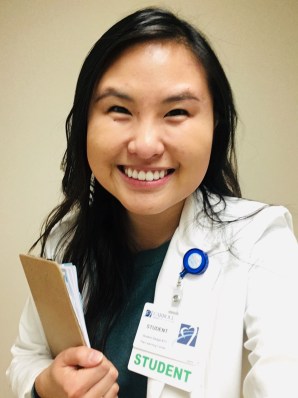
First Winter, First Clinical

ft: “Let it Go” by Idina Menzel

by: Isabella Dang

As much as I want to be smooth like Elsa and say, “The cold never bothered me anyway,” I can’t. This Californian (yes, me) is not so used to “real” cold.

Since coming back from the holidays, there have been some changes.  I am now a proud owner of a waterproof winter coat and an extendable ice scraper. But the biggest change was the transition into my CLINICAL rotations. (bum, bum, bum) As of today, it will be day 9 of clinical and I’m enjoying every part of it.

I didn’t think I would enjoy clinical this much.

Some of the lessons I have learned so far in this rotation are playing in my mind like the 2014’s Academy Award Winner for Best Original Song, “Let it Go.”

“The snow glows white on the mountain tonight” (Day 1)

IMG_8973
College Park got 9″ of snow the night before my first day of clinicals!

As my car is warming up, my muscle memory is kicking in as I scrape off the ice on my car windows. It’s my first day of clinical and it would be a nightmare if I was late. After an hour commute, I drive up to the quaint Carroll Hospital which sits on a hill at the edge of Westminster, MD. Carroll is “home” for the next 4-weeks.

On my first day, I got my badge, went through a mini-orientation and visited patients with a dietitian. After rounds, check-ups, face-to-face consults, it was time to vigorously take notes on how to chart in Carroll’s electronic medical record (EMR). Thousands of questions later, it was time to go home.

The day flew by!

My mind feels stretched as a lot was deposited into it. After my first taste of clinical, I drove home with an eagerness to drive up the next day.

“Well, now they know” (Day 4)

I forgot a lot of my undergrad Medical Nutrition Therapy.  When the Registered Dietitians (RD) would “quiz” me, I would communicate panicked looks because of my inability to answer some questions. The RDs would chuckle and say, “It’s okay if you don’t know, you’re here to learn.”

And boy, did I learn!

I learned the most powerful answer to give is “I don’t know.” Honesty goes a long way, and as I embraced a growth mindset, I was learning and applying lessons faster than expected. I took notes on everything: terms I wasn’t familiar with, unpronounceable medications, nutrition interventions and names of the nurses who I will interact with. Every bit counts!


47uir5L5R1SJvWFrmCZYrw_thumb_290
This is the pocket notebook I use to jot down notes

Early on, my preceptor taught me how propofol (an anesthetic) affects an RD’s tube feeding calculations. Fun fact, propofol is a lipid solution that adds 1.1kcal/ml. I quickly jotted down this fact and did further research that night. The next day, during critical care rounds, one of the doctors mentioned how a patient is on propofol. He then looked over at me and asked if I knew what propofol was and how it affects tube feeding rates. Luckily I knew the answer to that question! By the end of the first week, I was writing in the electronic medical record and having my notes checked off by the RDs. It’s a great feeling to have your first note critiqued, corrected and signed off


“Let it go, let it go” (Day 5)

My preceptor:  “I want you to take the lead on this patient.”

Me: (internal panic) “Okay.”

My preceptor: “Great, let’s go!”

I felt awkward knocking on the patient’s door and soon discovered my interviewing skills were rough. After meeting the patient, my preceptor gave me feedback. I communicated having a lot of nerves going in and she assured me they go away the more you do it. I took in her advice and understood how I have to continue to practice, prepare and ultimately get out of my comfort zone.  Let it go!!!!

IMG_0029
I “made it” on to the RD agenda board.
IMG_0028
On my way to see a patient 🙂


Time to see what I can do… test the limits and break through (Day 6)

According to my mini- case study assignment, I need to be the primary dietitian for the case I will present. I will perform an initial assessment, create chart notes and diet instructions, and, if possible do subsequent assessments. “As I initially read the assignment, I worried that it would be an impossible task. But I had to go back to GROWTH MINDSET. Let’s see what I can do. Thankfully, I was able to find a patient who fit my case study criteria.

Applying the “let it go” mentality, I knocked on the patient’s door and walked in prepared and less nervous. I had a great conversation with her, and she is looking forward to seeing me again! I’m excited to monitor and evaluate her progress.

The cold never bothered me anyway (Day 7)

As of writing this blog, it’s been a full 7 days of snow and clinical. Overall, I’ve had a positive experience, but I know not every day will be positive. That’s just reality.

But as long as I’m learning something (or a dozen things) each day, it’s a good day.

I must say, my clinical rotations have sparked something in me that I can’t fully identify yet. Clinical is fun! And as I’m getting more used to it, I’m getting more used to the cold.

Broadening My Clinical Horizons at Holy Cross Hospital

– by Kira Bursaw

Holy Cross Health is a health system in Maryland with two locations: Silver Spring and Germantown. For the last three months, I have been in my clinical rotation at Holy Cross Germantown. It’s a very new hospital with about 80 beds and one dietitian. I loved the experience and can see myself as a clinical dietitian in the future because of the amazing people who I was fortunate enough to learn from there. However, the majority of the hospitals in this area aren’t so small, and I wanted to have some exposure to the life of a dietitian in a larger hospital. When it came time to pick a 2nd clinical rotation (like a clinical elective for 1-2 weeks at the end of the clinical rotation), I jumped at the chance to head over to Holy Cross Hospital in Silver Spring. Coming from a smaller hospital, I hadn’t been exposed to some of the healthcare specialists which can be found in larger hospitals. Holy Cross Germantown did a great job of teaching me the basics of being a clinical dietitian and Holy Cross Silver Spring extended that learning by getting me out of the office and on rounds with a variety of healthcare specialists.

A big topic that dietitians and dietetics students hear about often is pressure ulcers and wound healing. I’ve received many nutrition consults for “the presence of open or unhealing wounds.” This label is most often given to patients who have a pressure ulcer, which can be stage 1 to 4 in increasing severity or unstageable if there is over 50% dead tissue. Before my rotation in Silver Spring, there was much information I could share on the role of dietitians in wound care and what the wound nurses’ notes said, but the problem was that I hadn’t had first hand experience. So on my first day at Holy Cross Hospital I joined Rezia and Agya, the wound nurse and the nurse she was training, respectively, for four hours of wound rounds. We went all over the hospital and to every single floor- from observation in the basement, to the SICU on the first floor, ICU on the second floor, and five more floors above that in two different buildings. I was able to see stage 1, 2, 3, and 4 pressure ulcers, as well as unstageable and deep tissue injuries. I also got to see how these wounds are cared for and the different types of ointments and dressings that are placed on them. There was a special silver gauze that was placed on diabetic foot wounds for one patient. There was a collagen gel that we placed on a stage 4 pressure ulcer of another patient- and the tube costs over $300! The nurses I shadowed seemed to know everyone in the hospital, and it wasn’t just by name; they knew about families and vacations and so many details about each person that you could tell they truly connected with everyone. I was very impressed by the proficiency with which they conducted their job and their personable attitudes when interacting with patients, visitors, and staff members alike.

I learned so much about the neonatal intensive care unit (NICU) from Olivia, a NICU dietitian. Olivia shares her office with Letitia, the pediatric pharmacist, and the two of them graciously shared their time with me. Olivia started out by teaching me about the most pressing issues premature babies face. Two of the most critical issues are necrotizing enterocolitis (NEC) and patent ductus arteriosus (PDA). Necrotizing enterocolitis is a condition I was familiar with from the adult population, but I had no idea how serious it is in the newborn population. According to Olivia, NEC is the number one greatest threat to babies surviving an early arrival, and a lot of what they do in the NICU is to try to prevent or minimize NEC. Olivia and Letitia showed me a video that explained the PDA defect; it gave me a better understanding of why some babies with this defect are so tired during feedings that they are not able to eat enough to gain weight. Babies that have an open PDA image-2.jpegtypically receive fortified breast milk via a tube (enteral nutrition). It is important to maximize nutrition care for these babies to keep fluids to a minimum while still providing adequate calories and protein to help them grow. Next, Olivia explained the different types of milk that the babies in her unit receive. Breast milk is used as the base in most cases and from there different additives can be incorporated to increase the caloric and nutrient density. The NICU uses human breast milk with an added fortifier. Human breast milk has approximately 20 calories per ounce and the fortifier can add an additional 4, 6, 8, or 10 calories per ounce. The NICU also uses products that are 24, 26, 28, and 30 calories per ounce, which can all be mixed with breast milk to create higher caloric density formula. Olivia did a good job of explaining all of these calculations and numbers, and the picture of the chart is a great reference that hangs on her wall.

There are two types of rounds that happen in the NICU: the true interdisciplinary rounds with all professions that treat the babies, and then there are the nutrition rounds that happen every day with just Olivia and the neonatologists. I participated in the nutrition rounds with two different neonatologists. There are four different rooms, labeled A through D, where the babies live around a central hub. The lights are dim and the rooms are quiet, despite all the nurses, parents, and other adults in the area. One cool thing I noticed was that there was a NICU Cam over every bassinet and incubator. These cameras are for parents to be able to see their newborns whenever they want, which must be very reassuring to new parents who can’t take their babies home yet. The neonatologists reviewed the caloric content of each baby’s feeding with Olivia and shared their concerns for the baby’s progress. One baby had patent ductus arteriosus and the neonatologist explained that the condition is being closely monitored, with the babynicu formula likely to fully recover on its own. I was able to follow the discussion thanks to Olivia’s teaching on PDA. Olivia explained her recommendations of various calorie densities, always relating it back to how many grams the baby had lost or gained over the last week. I was very impressed by just how critical every numerical value was. After we finished rounds, Olivia took me to the room where the milk and formula is stored, to show me all of the products she taught me about. I have never seen so many different types of formula in one place! There were also two large freezers with the mothers’ breast milk stored and labeled with the infants’ corresponding ID stickers, as well as the bottles of human milk fortifier.


My 2nd clinical rotation was incredibly fast-paced and I got a crash course in a lot of areas that I didn’t have much prior experience. In addition to my time with both the wound and NICU teams, I was also able to visit the surgical intensive care unit (SICU) with the dietitian that covers the area and sit in on their rounds, which were quick and to the point. I’m very happy with both the solid base I received during my main clinical rotation in Germantown, and the supplemental training I received at Silver Spring.Together the teams at the two Holy Cross Hospitals provided me with a well-rounded understanding of all that dietitians do in a clinical setting.

Wellness Corporate Solutions Turned My World Upside Down

By Rachel Miller

Those familiar with an office workplace, or any work environment for that matter, know that task lists are commonplace. They act as foundational pieces to company productivity; encompassing goals and reflecting company values. I was greeted with a task list of my own on my first day interning at Wellness Corporate Solutions. On it, “do a headstand” sat comfortably at the bottom of the list. It was at this moment that my views on office life turned upside down, and apparently, I wasn’t far behind them.

Processed with VSCO with au5 preset

My task list also included project work such writing the WCS Portal Blog posts for the month of January, creating recipe cards, gathering educational resources for health coaches, accumulating research studies regarding diabetes coaching programs, presenting this research, and listening in on coaching calls whenever there was an opportunity.

Wellness Corporate Solutions (WCS) is a part of UMD’s dietetic internship program technology rotation. Not all interns get to experience WCS’s healthy and active workplace in Bethesda, MD. I am lucky to have the opportunity to be immersed in such an environment while working to improve the health of workers on a nation-wide scale. At WCS, employees are encouraged to move often and eat well. Such encouragements are supported by fun workplace outings to yoga studios, for example, but they don’t stop there. All employees are welcome to join in Salad Fridays and daily 7-minute workouts These are some of the ways WCS elevates energy levels and fosters strong work productivity. They aim to be a model for workplaces and their workers across the country. Walking into the WCS headquarters is like walking into your own personal gym. You will see treadmill and standing desks, weights, bands, and a pull-up bar. There are no excuses to not be active in this office and I love it! As they set an admirable example, they also try to positively impact clients in all different fields through biometric screenings, health education, seminars, health fairs, coaching calls, and much more.

Processed with VSCO with fp4 preset

During my time here, I’ve learned a lot from my assigned tasks and from the people I have met. I believe that working at WCS has taught me how to bring nutrition to life through writing, something I have always valued and want to incorporate into my dietetic career. Being a food blogger, I was excited to dive into writing blogs for WCS. What I didn’t realize is how much research and time it takes to develop the right voice to effectively engage readers. Coming out of my clinical rotation, I had to transition into a creative mindset. After jumping around from task to task, dipping my toes in to get a feel for what was expected of me, I found my voice in my writing again. I had stepped away from my food blog since starting the internship, but my work at WCS has encouraged me to jump back in with my new-found writing voice.

Processed with VSCO with fp4 preset

There is a lot of value in bringing nutrition to life through words. Our world heavily depends on social media. Its popularity continues to grow as individuals can “google” virtually any answer they want. I may not be able to control what information they find, but I can contribute accurate information to their search options. Content creation has a heavy impact on the face of nutrition and what people believe to be true. I want to be a part of the message that is being delivered to the public; making sure it is as accurate as possible to improve overall health outcomes across all populations.

In addition to blogging, I also learned about the research that goes into developing WCS coaching programs. The coaching programs at WCS sit on top a very solid foundation of research. They aim to provide their clients and their coaches with information from the most up to date and evidence-based studies. WCS eventually plans to develop a diabetes coaching program. A large part of this program’s development is doing research on aspects of other successful health coaching programs for individuals with diabetes, making note of these aspects, and then molding them to create a new program. I was asked to put together a resource list of evidenced based research studies and then present them to members of the WCS team. I enjoyed this task because it helped me focus on important aspects of certain studies and pull information that could potentially aid in the development of a future diabetes coaching program at the company.

During my time at WCS, I also listened to several coaching calls and had the opportunity to sit in on different meetings, interviews, and webinars. I really enjoyed this particular webinar for the health coaches that reviewed motivational interviewing and deconstructed how using client’s values could help them achieve their goals. This was a webinar that relied very heavily on participation, allowing the health coaches to share their personal client successes. It was a great learning experience to see motivational interviewing in action, helping to change people’s lives, and not just in a classroom setting.

Processed with VSCO with au1 preset

Wellness Corporate Solutions turned my world upside down, literally and figuratively. I am excited that I see office life differently than I have in the past and that I have seen health and wellness content creation in action. Although I was just an intern, I feel like my work made an impact and that for 4 weeks I was part of the WCS team. I may not be able to control what individuals find on the internet, but I can contribute quality information, hopefully having a positive impact on more than one life.


BMI, Bariatric Surgery, and Best Practices for Disordered Eating

By: Tyler Boatright


What can we do for patients suffering from eating disorders? How can we help obese patients lose weight without bariatric surgery? Who is a good candidate for bariatric surgery?

Every morning since my clinical rotation started, I’ve been secretly crossing my fingers and hoping I didn’t get assigned any of those patients. It’s not that I don’t want to help them, it’s that I wasn’t sure I knew how to help them.  Lucky for me, our most recent Joint Class Day, hosted by the Johns Hopkins Bayview Dietetic Internship on December 3rd, focused on Obesity and Disordered Eating.

This education-packed day included several valuable lectures from experts, collaborative case studies with interns from other dietetic internships, and inspiring personal stories about bariatric surgery.  In attendance were dietetic interns from the host site, Johns Hopkins Bayview, as well as University of Maryland Eastern Shore, University of Maryland Medical Branch, the National Institute of Health, the US Army, and the University of Maryland College Park.

The morning began with a presentation by Maureen Gately, RD, LDN, a dietitian at the Center for Discovery in Alexandria, VA. She provided us with a brief background about the different types of eating/feeding disorders, behaviors, and diagnostic criteria. Then she spoke about her experience working as a dietitian in an inpatient mental health facility specifically geared towards helping teens experiencing disordered eating. After that, we split into groups to work with interns from other programs on a few case studies. I noticed that we all had the same base of knowledge, but began approaching the problem from different places based on our exposure to over the last few months. After we’d solved our case study we came back together as a group and discussed our conclusions. This presentation helped set me up with background information on eating disorders that served as a solid foundation for the rest of the day.

scale-diet-fat-health-53404

Our next speaker was Christie Williams, MS, RD, LDN, CDE, an advanced clinical dietitian who led our second session, providing us with evidenced-based strategies, techniques, and methods for dietitians to help obese patients lose weight without surgery. Motivational interviewing, physical activity, food diaries, and rebuilding a healthy relationship with food are just some of the strategies we learned about to help counsel and guide patients towards weight loss. This presentation was incredibly valuable for me, especially as an intern within the first few weeks of my clinical rotation. I know that I will be able to show patients the value of weight loss and provide education about how to lose weight without sacrificing health.

After a brief break for lunch, Suzy Carobrese, MS, RD, LDN, CDE, outpatient dietitian at Johns Hopkins, Bayview, presented on the efficacy, benefits, risks, and complications of using bariatric surgery on the overweight and obese population. We were also able to see up-to-date statistics on how common each type of surgery is, criteria for patients to be eligible for these procedures, and expected patient outcomes. This lecture helped me understand how the bariatric surgery puzzle piece fits into the overall puzzle of healthcare, and how we as dietitians are an important part of helping put together that puzzle.

pexels-photo-1250655

Our last lecture was given by Julie Hagan, MS, who had a bariatric surgery in 2011. She shared her touching personal story about how bariatric surgery helped her overcome numerous disease states and polypharmacy; she now lives a healthy, happy life. It was really valuable to be able to hear this patient’s first-hand account of how she got ready for the procedure, how she recovered after the procedure, and what her typical day-to-day looks like now. It was fantastic to have her share her personal anecdote as the grand finale for our day of learning about interventions and treatments for obesity.

I truly appreciate the opportunity to learn from lectures given by professional experts, while collaborating and networking with my peers. The things I learned today will not only benefit me for the rest of my internship, but will help me make informed, educated decisions throughout my professional career. I’m so glad I was able to attend this Joint Class Day and I cannot wait until I’m able to put this new knowledge into practice!

Testing our Trays


By Michelle Guarnieri

When I stepped into my clinical rotation and Meritus Medical Center, I was expecting feeding tubes, intubations, diabetes education, and a lot of calculations. I was not, however, expecting to have components of foodservice mixed in with my Intensive Care Unit (ICU) rotation. It turns out that these two areas of nutrition crossover frequently, and dietitians play a major role in foodservice and the safety of the patient.

At Meritus, patients receive daily menus specific to their nutrition needs. From this, they choose their breakfast, lunch, and dinner selections; then trays with their desired meals magically arrive at set meal times. Seems simple right? Not so much. Meritus has five IMG_0207floors that hold close to 250 beds and is usually close to capacity. That means a lot of patients need diet-appropriate and safe food served at each mealtime. According to safety protocol, hot food should be kept above 140 degrees F and cold should be under 40 degrees F. Temperatures within this range make a hostile environment for most bacteria that cause foodborne illnesses, so these temperatures are important to keep the patient’s food safe. ICU patients are often immunocompromised, that is, they are at increased risk for foodborne illness and other infections. Therefore, food safety in this population is vital.

This poses the question: how is the hot food going to stay hot and the cold food going to stay cold during delivery? The foodservice staff taught me how they do this. Hot food is kept under a cover on the tray separate from the cold food. This prevents the steam from the hot items from heating up the cold food. The trays are then loaded onto an insulatedIMG_0208.jpgcart that is covered on both sides and the top, much like the ones used by flight attendants on airplanes. Trays are sent in batches to each floor, so the second floor is served then the cart is returned to the kitchen to load the third floor, and so forth. However, there’s one more problem. It takes about five minutes to get food to the floor, then each floor has about 50 patients that need meals. I wondered, is it possible to maintain a safe food temperatures even for the very last patient served? It’s possible but not easy, and needs to be monitored. That’s where dietitians and test trays come in.  Every month, each of the five dietitians order a meal from the kitchen and report on the temperatures, taste, portion size, and appearance of the food when it’s delivered to them. That’s 60 test trays every year! During my time in clinical, I got to try this out for myself.

It’s getting cold out, so I ordered grilled cheese and tomato soup to warm myself up. I also added Greek yogurt for protein and a side salad to get some vitamins. The ICU is the  IMG_0211last floor to be served and I would be the last one given a tray. This is meant to simulate what it’s like for the last patient served to get their food. While I waited for my comfort lunch, I got my thermometer and alcohol wipes ready to check the temperatures. I reviewed guidelines for safe foodservice and looked over the evaluation form.

When my food came, I checked the cold food first, like my preceptor had instructed, then moved on to the hot food. I made sure to document my findings and communicate them with my preceptor and the foodservice staff so they could have feedback and make changes, if desired.

Test trays help to improve both the quality and safety of the hospital’s food, and are a great learning opportunity for everyone involved. I’m glad I got to experience this food service evaluation procedure firsthand!