Finding the Line Between Promoting Health and Preventing Disordered Eating: Part 1

By Caitlyn Lazorka

Finding the Line Between Promoting Health & Preventing Disordered Eating

This is the first of a two-part series where I explore the line between promoting health and preventing disordered eating, particularly amongst youth. In part 1, I will discuss why this line is important to find and what my plan is to find it. In part 2, I will share my findings and suggest practical ways that educators and families can promote healthy eating patterns while also preventing disordered eating. 

Part 1

The Big Question

Throughout all of my rotations, I keep coming back to the same question: How can I provide nutrition education, especially to children, while also preventing disordered eating? I have become particularly in-tune with sensitizing nutrition information and identifying potentially harmful nutrition education because of my position working at a residential eating disorder facility. The line between promoting health and preventing disordered eating is important to identify when working with children, whose ears and brains are particularly sensitive to this information.

The Problem

In undergrad, I learned about motivational interviewing, medical nutrition therapy, community nutrition, foodservice nutrition, sports nutrition, disease prevention, disease management, weight loss techniques, research techniques, the science behind muscle-building, and how to measure the effectiveness of nutrition interventions. What I did not learn, however, is how to prevent disordered eating. It sounds like such a small idea or skill, but in reality it is critical and, in my opinion, it is not discussed enough. The onset of eating disorders is usually during adolescence, which increases the importance of smart and safe nutrition education. Due to my experiences working at a residential eating disorder facility, I am determined to advance quality nutrition education that both prevents restrictive eating and promotes a healthy attitude toward food and diet. 

My Plan

I decided to answer this question while taking on a research project during one of my rotations at a community site that provides nutrition education to elementary school children. When looking over potential course material for nutrition education classes, I saw a commonly used technique of having children give a thumbs up or thumbs down for various foods. While the intentions of this game are positive – to promote healthy foods and educate on what foods are not health-promoting – I wondered if there is a better way to deliver this information.

My goal of the research project was to identify best practices when teaching children about nutrition, which, to me, means providing positive messages about foods and eating behaviors. After discussing my research observations with my preceptor, she was equally as interested in finding the line between promoting health and preventing disordered eating. Check back to see part 2 of “Finding the Line Between Promoting Health and Preventing Disordered Eating” to read about my findings. 

Podcasts to Both Entertain and Inform

By Linh Nguyen

            In today’s information age, most of us love to create, send, receive, and consume information. Information is ubiquitous. Dietitians and nutritionists have quite a big challenge in ensuring clients and patients are accurately informed with the latest evidence-based nutrition information, at the same time dispelling the nutrition misinformation portrayed through the media, online, in commercials, and in social media. The tool that dietitians and nutritionists can use to help set the record straight is nutrition informatics. The Academy of Nutrition and Dietetics define nutrition informatics as “the intersection of information, nutrition and technology.” It is beneficial when dietitians use a variety of technological skills to convey current, evidence-based nutrition science to reach targeted populations.

            Podcasts are a great platform to provide nutrition information at almost no cost in a short amount of time to a large amount of listeners. According to Wikipedia, podcasts were once known as “audioblogging” and was started in the 1980s, but really became common in late 2004. Podcasts serve purposes of entertainment, education, relaying the news, playing music, among many others. Personally, I like listening to podcasts that educate and entertain simultaneously.

            Creating a podcast about nutrition was a fun assignment for me during this dietetic internship. I realized that speaking to an audience from a rehearsed script is easier than speaking in real-time in front of an audience. While creating a podcast script, I enjoy that I can interject my thoughts while providing tips on creating healthy habits in an informal, conversational manner. Ultimately, the goal is to provide useful information that can be used by people to improve their diet and health. Podcasts are a fun and easy platform for dietitians to talk to a wide audience about a specific nutrition topic.

            The next step for me is to create more podcasts. I think creating podcast episodes that follow the same nutrition topic over a series can be a great addition to any dietitian’s toolkit. By creating short podcasts that follow the same nutrition theme or topic, the listener can receive small amounts of nutrition education and information over a long period of time. This strategy helps to reinforce information and keep the listener engaged and interested in nutrition. I enjoyed creating a podcast on creating healthy habits. I believe that this topic can be expanded upon. Some possible follow-up topics include delving into the different types of habits that can be created, how to keep trying to create the habits, and covering how a person can assess and monitor their habits. Each episode of the healthy habits series can illustrate a short story or example, tips and strategies, and/or include emerging research and science.

            I have considered many other topics for future podcast series. I believe these have the potential to be engaging, entertaining, and make a beneficial change in the listener’s diet and lifestyle. Some of my topic ideas are protein intake, cooking methods, grocery shopping tips, reading nutrition labels, and meal planning. Each podcast episode can focus on a strategy, fact, and tip that the audience can practically apply into their daily lives. Podcasts can really speak to people that learn by hearing. Another benefit of podcasts is that the recording can be paused, replayed, and listened to repeatedly. Podcasts can also be listened to at each person’s convenience.

Interviews with prominent researchers, dietitians, influential media personalities, politicians, and other guest speakers can attract a specific audience as well as a wide-ranging audience. Another thing I have learned in my internship is that it is important to consider your target audience and your brand when you select topics and invite guest speakers. You always want to provide information that is credible, meaningful for your audience, and true to your brand. Guest speakers can infuse a fun and engaging energy that your listeners may enjoy which, hopefully, will resonate with them. While it could be tempting for people to speak their mind and opinions about nutrition, it is important to always base the podcast content on evidence-based, practical approaches that the listeners can use in their lives. A dietitian can foster a relationship and build community with their audience through podcasts.

Infographics and Outreach

By Frances (Fran) Miller

While in a rotation with Maryland Food Bank, I was able to refine my skills in creating infographics and writing. It was important to understand my audience to create an end product that suited them best. By creating a product targeted towards a specific audience, the information can be both applicable and interesting to your audience. 

MFB provides food but also helps clients make healthy informed meal decisions. Infographics are used to provide important health information in an easy to understand format. These infographics are distributed in tandem with recipes; each infographic focuses on a component of the recipe it is paired with. While in my rotation at MFB, I was tasked with creating infographics that helped inform and entice participants to use the knowledge provided in making future decisions.

While creating these infographics, I was able to learn more about the community they serve. It was difficult at first to predict what reading level and topics would best suit their average participant. For example, I created an infographic for peanut butter. Knowing that this is a common allergen, I wanted to mention some alternatives for those unable to eat peanut butter. After doing some background work, I later realized alternatives to peanut butter would likely be too expensive for many of MFB’s clients. I later applied this knowledge to avoid costly alternatives when making an infographic about dairy.

To ensure the text was easy for participants to read, I began using an online tool to assess the reading level of my writing. I then adjusted my writing to make my infographics more accessible. I also added additional recipe ideas that I sourced from the supplemental nutrition assistance program (SNAP). I used SNAP because they create recipes that use just a few inexpensive ingredients and basic kitchen equipment. 

This experience taught me to gear my language and content to my target audience.  I learned to strike a balance between under and over estimating clients’ knowledge base. If I overestimate how much they know about the topic, the infographic would be too difficult to understand and would be inaccessible. If I underestimate the clients’ knowledge, they won’t learn anything new and may even be insulted. Either way, the infographic will not serve its intended purpose.

Through this process, I was able to better understand my audience to create a product that would be accessible and helpful to them.


RESPONSIBILITIES OF A NUTRITION PROFESSIONAL IN SOCIAL MEDIA

By : Kerri Schumacher

Love it or hate it, you have to admit social media is a widely used tool for marketing, influencing, branding, and grabbing attention. While much in social media goes unchecked, my internship experiences have taught me that dietitians have a responsibility to uphold. Some individuals and companies share an overwhelming amount of misinformation related to diet and health via social media every day. Open any social media platform and you will find erroneous information on diets, false interpretations of nutrition guidelines, and supplementation schemes. There are even some people who call themselves “nutritionists” who have no credible training and put out misinformation to the public. Unfortunately, many of these posts are not tagged “unreliable,” or “not true.” It is not always easy for those using these social media platforms to know what is credible. 

An emphasis on informatics at the UMD’s dietetic internship has allowed me the opportunity to complete various projects using technology, internet, and social media platforms. As I researched for credible information during these projects, I became aware of the issue of misinformation presented in social media. Many of my internship projects, such as constructing a website, compiling nutritional infographics with researched information, creating a professional LinkedIn account and posting for the internship’s social media accounts, are helping me hone my professional communication skills.  I am grateful that I will be a voice the public can turn to. I also appreciate the technology day lectures, which are given by dietitians who are skilled communicators. They are teaching me so many useful and interesting ways to connect with a variety of audiences. Perhaps the one that surprised me the most was a talk about connecting to certain audiences about nutrition via TikTok..

I have come to the conclusion that social media platforms can be more than what some call a “waste of time,” or a “mental break;” they can be “marketing tools on the go.” Some key tips and tools I have learned so far help me correctly use social media to foster my brand. I have mentioned some below because they are way too valuable not to share with you. Many dietitians share recipes, nutrition education and memes on social media. They even use social media to promote their private practices. If you are new to using social media professionally, or if you want to take your posts to the next level, here are a few tips that I learned. 

First, you must consider your audience and  gear your post to target them specifically. Answering, “Who is my audience?” will help you tailor your message to your desired audience. For example, if my post is about spin classes and the benefits of doing vigorous cardio/weight lifting, an older adult might not be as engaged considering they may or may not be able to perform that type of intense exercise anymore. Next, you will want to identify what you want your posts to accomplish– Are you trying to …inform, entertain, solve a problem, empower or relate to your audience? Each one of these sets a direct intention on your purpose of sharing, which you can then use to create what your post will look like and how the content is made. This encourages the thought process of keeping their engagement along with promoting your account.

Creating an engaging social media post is a good first step, but I have learned there is more to consider before posting. Each social media platform has ways to increase engagement. Knowing about a platform’s algorithm can help you boost your messages. Algorithms tend to look at views, comments, likes, and re-shares when internally ranking posts. There are so many strategic things you can do to influence if a platform promotes your posts that I can’t cover them all here. I will mention a couple important ones. Timing is definitely something to consider. If you post at a time when your followers are online and most active, you give yourself a better chance of getting more likes. Another common way to increase engagement is by using hashtags. For some platforms, you can add relevant hashtags to your post to reach people who are interested in your topic; how many hashtags you might use varies with each platform.

To get the most out of my social media accounts, I learned to gather analytic information. I use that analytical data to assess how well my targeting worked and make adjustments for future posts. Below is a picture to show what this looks like. This example shows the age range and gender that this specific account has reached. I can use this, and other analytical data, to see if I am reaching my target audience.

 Last but not least, you must consider research. Dietitians have a strong science background and are trained to discern between credible and questionable nutrition information. We must make our voices heard by providing quality nutrition information that counters false nutrition claims. The easiest way to make sure you are using credible recommendations is to go back to the source. Is the website a .gov, .org., or .edu? Does it correlate with the US. Dietary Guidelines for Americans or the Academy of Nutrition and Dietetics? Paying attention to where the information is coming from should be the top priority.

Each month, I have put these keys to social media success into practice by posting through the UMD Dietetic Intern Instagram and Twitter. I have included one of my previous posts along with the captions so you can see these tools in direct use. The first one refers to an infographic I made during my bariatric surgery rotation at INOVA. I was explaining “Tips for Healthy Grocery Shopping,” so that bariatric surgery patients could incorporate healthy eating habits at home. I was hearing how the changes they had to make to their diet in order to prep for surgery and become ready for post-op was becoming stressful for them. I thought grocery shopping tips would be a great starting point to gear their focus for preparing meals at home. My goal was to provide tips to keep them from becoming overwhelmed at the store. You can notice the use of the hashtags along the bottom as well. 

Right now, my content definitely varies on topics depending on my rotation or what I learn during a specific experience,  but it has come a long way since I started. In my opinion, it is important to mention and spike conversations on topics like these in order to make improvements for the future. It is crucial to not assume everything on the internet is true. I will now leave you with this:  I challenge you to find one post on Instagram and see if you can determine where the information came from. Ask yourself the right questions, dig deeper into the details, and keep your eyes open for next time.
How to Confidently Create Your Personal Brand in the Dietetics Field

By: Skylar Sites

Being halfway through my internship, I am understanding the importance of personal branding for my dietetics career. Personal branding is creating the perception of yourself, based on your abilities, experiences and achievements. It is a buzz phrase I heard often during college, but until the training I received in my internship, I didn’t fully grasp its value. We often get shy and feel uncomfortable when talking about building our personal brand because it seems like we are going to have to brag or sound self-centered. To some extent, this is true but building your personal brand is so much more than that, and it is imperative in the field of dietetics. Personal branding is useful in marketing yourself to potential employers.

During my undergraduate career, I created a LinkedIn profile as well as a personal website to apply to dietetic internship programs. I struggled with designing the website in a way that looked visually appealing while also displaying all the projects and work experiences that I believed to be relevant. Thankfully, from the beginning of the University of Maryland’s dietetic internship we had lectures and workdays to develop and enhance our personal branding. I decided to create a completely new personal website that used colors and designs that showed my personality in a more accurate manner, while still displaying all the work and knowledge I am gaining in my rotations. I also acquired the comfort to interact with others and post regularly on my Linkedin profile. I feel confident and have great pride in the personal brand that I am creating for myself, but it definitely was not always this way. Check out my tips below to see how I transformed myself from someone who avoided talking about my accomplishments to someone who now shows off my personal brand with pride. 

  1. Create your personal website on a platform/site that feels comfortable to you. There are many site options out there such as Wix or Weebly. I chose one that I was comfortable using and that helped me be confident as I easily navigated the tool and designed my website without unneeded frustration. Personally, I switched over from Wix in college to Weebly for my current site because we learned that it is generally more user-friendly and allows you to alter the style more. 
  2. Think about your target audience when creating your personal brand. One thing my writing and personal brand instructors have hammered home is the importance of identifying my goals and my target audience. For example, they indicated that if you hope to gain a position working in pediatrics, you will want your personal brand to be colorful, fun, and engaging with lots of graphics. On the other hand, this style would likely not work well marketing to a job working with an older population. Understanding your goals and potential audience will help create an authentic and effective personal brand. 
  3. Always be true to yourself and be confident in who you are. Whether it is posting on professional platforms like Linkedin, sharing your work samples on a website, or creating content on social media; it is important to feel confident in yourself and stay true to your beliefs. This is the best way to create a personal brand that will help you obtain jobs and opportunities where you fit in best. When I first began creating my new personal website, I looked at so many examples that our tech team sent us. I got lost in all of these examples by others and almost created a site that reflected the style and goals of our tech team based on their sites. Thankfully, I realized this in time to change the color schemes, tab names, and overall layout of my site to better reflect the work I have done in college and thus far in my internship. 
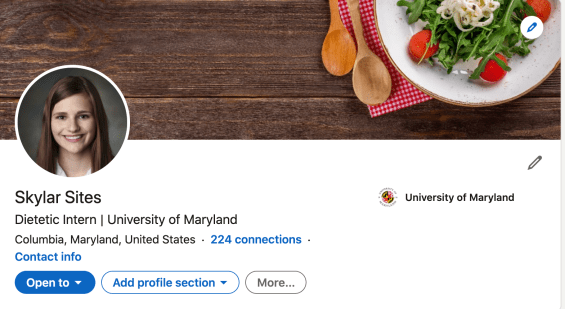
  4. One of the biggest tips that I learned throughout our branding training in the internship is that consistency is key. This means that if you have multiple sites (LinkedIn, personal website, Instagram, Twitter, etc.) that you use for professional functions, the design, style and tone should be similar. For example, I use the same cover photo on my LinkedIn account and the main page of my personal website. Furthermore, I use my profile picture (seen below) as my professional headshot on multiple platforms. I also have created a food and nutrition Instagram account where I chose to also use neutral colors because I want my brand to be seen as calm and inviting.
This shows the start of my LinkedIn profile. It is very similar to the main page of my personal website. Both utilize neutral background colors and food, which portray my calm personality and love for nutrition and cooking.

As a current dietetic intern and a future dietitian, I have learned that successful personal branding is essential not only for future employment opportunities but also to share helpful content with the public. Personally, I hope to use my nutrition education and social media presence to spread sound nutrition information backed by science to the general public. I found personal branding intimidating at first and I am so thankful that I have had many opportunities so far in my internship to break down the mental barriers I had created when it comes to marketing myself and my abilities. I hope that by sharing my experiences and my tips I can help motivate you to begin working on your personal brand as well!